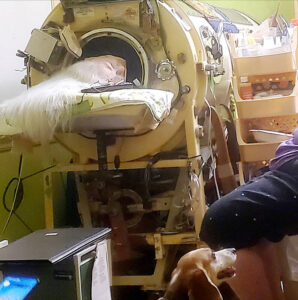
Martha Lillard, believed to be the last person in the United States to rely on an iron lung after surviving polio, has died at the age of 78. Lillard passed away on June 26, 2026, in Oklahoma, marking the end of an extraordinary life defined by resilience, determination, and perseverance in the face of overwhelming medical challenges.
According to her sister, Cindy McVey, Lillard was diagnosed with polio shortly after her fifth birthday. The disease left her paralyzed from the neck down, forcing her to depend on an iron lung—a mechanical respirator that helped her breathe—for the rest of her life.
Doctors initially believed she would not survive beyond the age of 20, but Lillard defied those expectations by living for more than seven decades.
“They told her she wasn’t supposed to live past 20 years old,” McVey said. “She had the enthusiasm and the drive to continue living and make the best of her life.”
McVey said her sister’s death was largely the result of complications related to long-haul COVID-19. According to her death certificate, the official causes of death were chronic pulmonary failure and post-polio syndrome.
Throughout her childhood, Lillard adapted to life in remarkable ways. She attended grade school for limited hours before continuing her education at home with tutors. During high school in Shawnee, Oklahoma, she participated in classes through an intercom telephone system that allowed her to communicate with teachers and classmates remotely—an innovative solution decades before virtual learning became commonplace.
Despite her physical limitations, Lillard experienced many milestones that once seemed impossible. Her family modified travel arrangements so she could accompany them on road trips, transporting her iron lung in a custom trailer. She also learned to drive for a period of time, demonstrating her determination to live as independently as possible.
Years of therapy helped Lillard regain limited movement in her left arm and legs, allowing her to prepare meals and live independently for many years despite her severe disability.
The internet became another gateway to the outside world. Curious about world events following the September 11, 2001, terrorist attacks, Lillard joined online chat rooms, where she met Baha Salh, a man from Egypt. The two developed a close relationship over more than two decades of online communication before finally marrying in February 2026 after Salh obtained a visa to travel to Oklahoma.
“They were really soul mates,” McVey said. “He’s extremely brokenhearted.”
Lillard’s health declined significantly after contracting COVID-19 twice during the pandemic. Already living with less than 25 percent lung capacity, her breathing became increasingly difficult. During the final five years of her life, she rarely left her home, and for the last two years she remained inside her iron lung almost continuously.
Beyond her medical story, Lillard was known for her creativity and artistic talents. She wrote poetry, composed songs, and even prepared her own obituary, later updating it to state that she “died of long-haul COVID-19” before her family added the date of her passing.
In recent years, Lillard and her sister searched unsuccessfully for technicians capable of repairing the aging iron lung that had sustained her life for decades. With few machines remaining and no one else known to rely on one in the United States, maintaining the historic equipment had become increasingly difficult.
Martha Lillard’s life stands as a remarkable testament to resilience, courage, and hope. Her determination to overcome extraordinary challenges inspired countless people and served as a powerful reminder of the impact of modern medicine, the importance of vaccination, and the strength of the human spirit.
She is survived by her husband, Baha Salh, her sister Cindy McVey, and other loved ones who will continue to honor her extraordinary legacy. May Martha Lillard rest in eternal peace.